Background
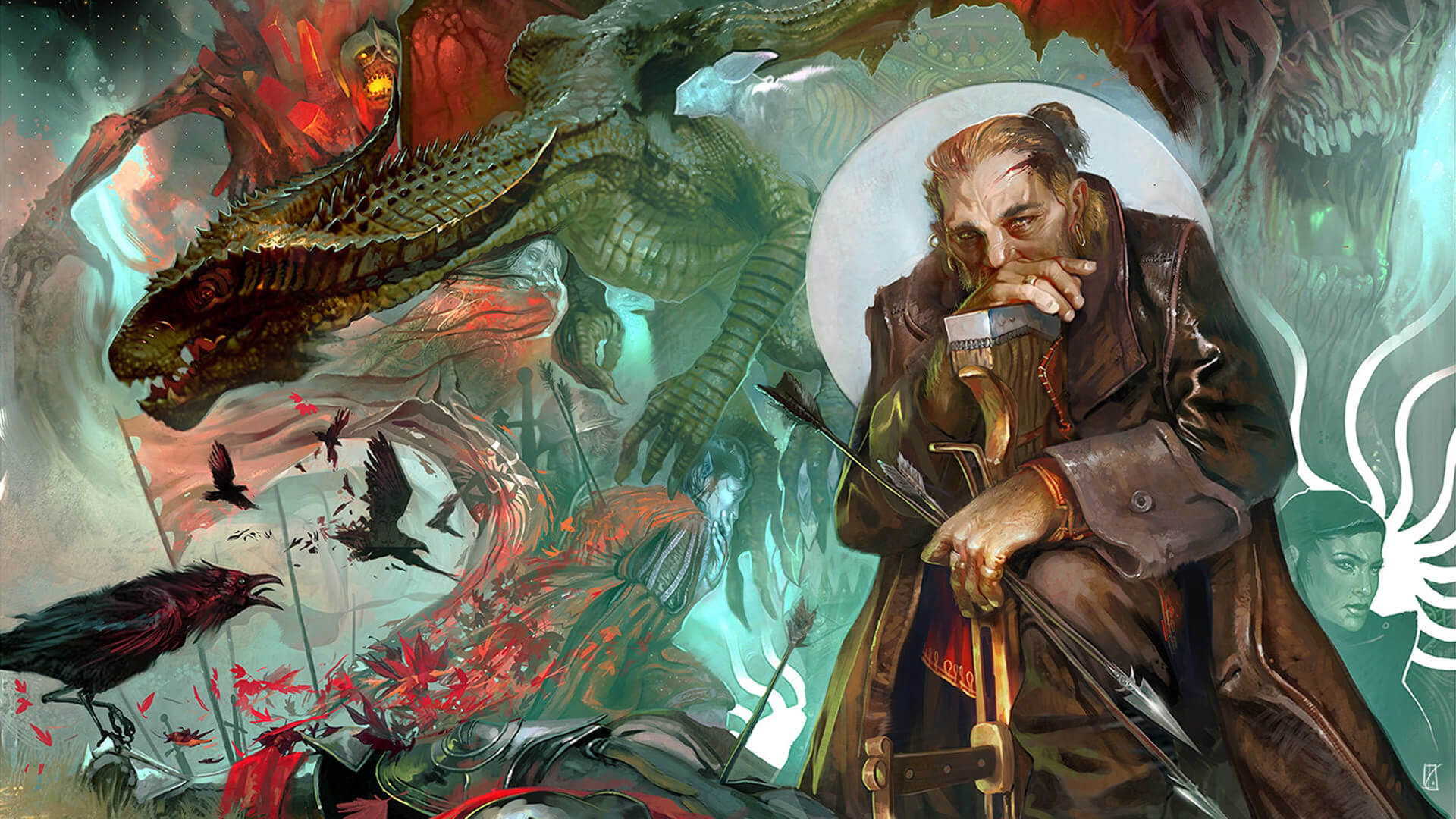
Varric Tethras is one of the most recognizable companions in the Dragon Age series, known for his charisma, storytelling, and inseparable crossbow, Bianca. This collectible pin set brings together three elements closely associated with Varric—his portrait, Bianca, and his necklace—in a custom display box inspired by his identity and connection to Kirkwall.
Challenge
The biggest challenge of this project was turning the client’s initial packaging concept into a production-ready structure that could also be reused across future products. The client wanted all three pins mounted on a single backer card, with the pins and character artwork clearly visible through a window when the box was opened. At the same time, they specifically required the window to be completely plastic-free. This ruled out the conventional PET/PVC window solution and required the box structure, window die-line, backer card position, and product mounting method to be reconsidered together so that both the “open-window display” and “plastic-free” requirements could work within one structure. More importantly, the same packaging concept would later be used for other characters and designs, so the solution needed to be repeatable rather than developed for just one product.
The second challenge came from the thickness of the pins and how the backer card would be supported inside the box. Each pin has a pin post and locking pin back, which creates noticeable thickness behind the card once installed. If a single flat card were placed directly inside the box, the pin backs would push it forward, leaving gaps around the edges and allowing the entire card to shift from side to side. The challenge, therefore, was not simply how to attach the pins to the card, but how to leave enough clearance for the pin backs while keeping the entire display card flat, stable, and securely positioned inside the box, with enough depth to create a more dimensional presentation.
What I did
The client initially provided a design direction rather than a complete structural solution. To determine how to make it work, I contacted several pin manufacturers I had worked with and shared the client’s requirements for a plastic-free window, single-card display, and gift-box format. I asked them to provide examples of packaging they had previously produced with similar design purposes.
I collected around 7–8 different structural references, compared their window designs, card-mounting methods, box structures, and production feasibility, and then combined and adapted the most suitable elements into the final packaging structure. Rather than directly copying an existing box style, I used these references to develop a structure specifically around the display experience the client wanted.
Once the box structure was confirmed, I focused on solving the thickness created by the pin posts and locking pin backs.
I tested several folding methods and eventually designed the unfolded backer card to be three times the width of the final display area. The center one-third holds and displays the pins, while the remaining one-third on each side folds backward.
Once folded, the two side sections create depth behind the display surface, effectively turning a single sheet of paperboard into a self-supporting three-dimensional insert. This provides clearance for the locking pin backs while keeping the front display surface flat. It also fills the otherwise empty space between the card and the box, preventing the insert from shifting from side to side without requiring an additional plastic tray.
I also optimized the spacing at the connection between the lid and the box body. Although this is a small dimensional detail, it directly affects how the box sits when opened and closed. If the spacing is too large, the connecting section pushes upward; if it is too short, the lid cannot settle naturally into position and tends to lift instead of sitting flush with the box.
To determine the correct spacing, I went directly to a digital prototyping shop and cut multiple die-line variations, tested different paper materials, and adjusted the connection distances through physical prototypes rather than relying only on dimensions on a drawing.
After multiple rounds of testing, I determined the final dimensions and spacing that allowed the lid to sit naturally and flush with the box without the connecting section pushing upward. When fully opened, the structure could also remain flat. These dimensions later became a structural reference for developing other boxes in the same series.
Outcome
The most valuable outcome of this project was turning what I learned through repeated prototyping and testing into two reusable structural solutions for future packaging in the same series.
One of the key results was a plastic-free window display structure. By refining the window die-line, opening dimensions, and the fit between the window and internal card structure, I was able to keep the products clearly visible while using the paper structure itself for positioning and concealment, eliminating the need for PET/PVC window film.
This structure could then be reused for similar packaging, reducing the additional testing, assembly requirements, and costs associated with conventional plastic window solutions.